Three Looming Threats to Digital Marketing for Healthcare

In the ever-evolving world of digital marketing, healthcare faces unique challenges. The regulations of the Health Insurance Portability and Accountability Act (HIPAA) have increasingly impacted every aspect of marketing, including analytics and campaign performance measurement. And in an era of data protection, adding to that burden are sensitivity of location data and the complexities of email marketing.

These threats pose significant hurdles for healthcare marketing. In this article, we will deep dive into these looming threats, exploring their implications and offering potential solutions to navigate these choppy waters.

Threat #1: Analytics and Campaign Performance Measurement

Imagine a world where every click, every scroll, every interaction on your website is scrutinized under the stringent lens of HIPAA regulations. Welcome to the reality of healthcare marketing post-December 2022. The Office of Civil Rights (OCR) under the Department of Health and Human Services issued a bulletin that redefined the scope of HIPAA, explicitly expanding protection to include future patients (not just current and past), as well as extending it to online tracking technologies like pixels or analytics.

This new guidance deemed that these technologies disclose electronic protected health information (ePHI), a term that now includes datapoints like IP addresses, device/advertising IDs, and geographic locations. What does this mean? Nearly anyone visiting your website could be considered a current, past, or future patient, and therefore their personal data must be protected.

Fast forward to March 2024, and the OCR reiterates its stance on tracking technologies. They also alleviated some pressure on pages unrelated to an individual’s healthcare, like jobs/careers or visiting hours, which would not indicate that the user has a patient relationship with the provider.

However, under both guidance releases, the OCR has stated that these technologies can still be used, as long as entities comply with HIPAA rules. But here’s the trouble — tech giants like Google and Facebook won’t sign a Business Associate Agreement (BAA), which is a contract that states both parties will appropriately safeguard the protected health information being handled and keep unauthorized users from accessing the sensitive data they receive. Without a signed BAA, any disclosure of protected health information is a no-go.

With warning letters, breaches, and lawsuits, the OCR and Federal Trade Commission (FTC) have demonstrated that they are serious. For example, the OCR and the FTC jointly sent warning letters in July 2023 to 130 hospitals and providers about the tracking technologies found to be present on their site. Then in April 2024, Kaiser Permanente announced a breach for having tracking pixels on their site that impacted 13.4 million individuals across multiple states. Lawsuits are even coming at state levels, with New York State Attorney General suing NewYork-Presbyterian Hospital for trackers.

The healthcare industry is in a conundrum. So, what’s the solution? Four main options have emerged for measuring campaign performance:

  1. Run an internal site-side server to contain all data and analysis in-house.
  2. Invest in a HIPAA-compliant analytics platform willing to sign a BAA.
  3. Use CDPs and privacy filter platforms (with BAAs) as “middlemen” to deidentify user data before analysis.
  4. Remove analytics altogether and rely on raw data reported by the media platforms.

The key takeaway? If you don’t have A, B, or C in place, get those pixels off your site! No matter how many times Google Ads, Facebook, or any media platform encourage you to track for conversions or say they can “help you find similar audiences by uploading your customer list,” they aren’t trustworthy with users’ data without a BAA in place.

Threat #2: Sensitive Locations

In a post-Dobbs world (the overturning of Roe V. Wade), sensitive locations have taken on a new importance. And it’s not just about where you physically are, but also where you are on the internet.

“Browsing and location data are sensitive. Full stop,” the FTC recently stated in a post discussing the privacy lawsuits it has been bringing. Even when stripped of traditional personally identifiable information (like name, date of birth, etc.), web browsing data is still considered sensitive. This has led to a slew of lawsuits against companies like Avast anti-virus software, location data brokers X-Mode and InMarket, and mobile mental health app Cerebral.

For healthcare marketers and advertisers, the OCR’s announcement in December 2022 expanded HIPAA-protected data to include unique identifying characteristics, numbers, or codes, which could encompass device IDs, which are used in retargeting and geofencing campaigns.

For those who aren’t familiar, geofencing is a hyper-targeted advertising strategy that uses GPS, Wi-Fi, or other location-based data points to set up virtual perimeters around a location and deliver ads to users who cross into that space. It has been highly effective for reaching new audiences based on their location behavior.

To this point, states are creating their own regulations around geofencing, even when it isn’t specifically related to a user’s healthcare. In July 2023, New York State passed a law that prohibits the establishment of a geofence or similar virtual boundary smaller than 0.35 miles around a healthcare facility to deliver digital advertisements to a person in that location, unless the advertiser is that healthcare provider.

This law, while intended to protect patients, has far-reaching implications on recruitment marketing, continued medical education promotions, business-to-business sales, and more. Other states like Connecticut, Nevada, and Washington have similar laws, and it’s only a matter of time before more states follow suit.

The FTC has stated they are even considering issuing privacy rules to restrict online behavioral advertising as a form of commercial surveillance. As advertisers, this raises concerns about reaching new audiences efficiently and effectively.

Threat #3: Email Marketing

Email, a cornerstone of many marketing plans, surprisingly makes it to our list of threats. Given the recent changes in HIPAA compliance and data privacy, it’s very important to be sure your email marketing is up to date. We have identified four main questions to review your internal processes and practices.

Are you CAN-SPAM compliant?

The FTC enforces the “Controlling the Assault of Non-Solicited Pornography And Marketing” Act of 2003. The basics of the rule are:

  • The content cannot be misleading to the recipient. All emails must contain an accurate representation of the sender in the name and body copy, as well as a clear, nondeceptive subject line.
  • It also must provide an unsubscribe link. The Act requires an obvious link for recipients to unsubscribe from ALL of the sender’s emails.
  • It must include a physical mailing address in the body of the email. Yes, an address (a PO box is acceptable) where unsubscribe requests can be mailed is a requirement even in this digital age.

Fortunately, most email service providers (ESPs) have built-in enforcement mechanisms to avoid the most common mistakes, but it doesn’t hurt to double-check that everything set up years ago is still accurate. Both agencies and senders are responsible for compliance, so protect yourself by making sure your agency or partners have appropriate agreements (BAAs) and by thoroughly reviewing all tests for compliance in order to avoid fines.

Is your ESP and/or Customer Relationship Management (CRM) HIPAA-compliant with a BAA in place?

Your first-party email list includes HIPAA-protected ePHI such as email addresses and names, and the platform can identify the content users interact with, so ensuring compliance in this area is crucial.

For instance, Mail Chimp, a popular ESP, is not HIPAA compliant. Constant Contact does offer HIPAA compliance, but only at certain subscription levels. Similarly, Campaign Monitor and Active Campaign are HIPAA compliant, provided you make the effort to get a signed BAA.

Do you follow best practices such as having double opt-ins and segmented lists?

These two practices ensure a balance between effective marketing and user privacy.

Double opt-ins, a method of obtaining explicit and unambiguous consent from users, have grown in popularity since the introduction of the General Data Protection Regulation (GDPR) in Europe and the California Consumer Privacy Act (CCPA). This practice of having the user confirm their sign-up for an email list via a confirmation link or code sent to their email is now considered a standard setup for email sign-ups. This will help reduce your reports of spam emails, increasing your chances of making it into the user’s inbox.

Another common practice is segmented lists, which allow users to subscribe to multiple “newsletters” or topics based on their interests. There are a number of ways to facilitate this — from service line, stage of life, or geographic location/region to a general monthly update or a recipe of the week from your dieticians and nutritionists — the options for engagement are endless. This approach allows for semi-personalized emails in a compliant manner and keeps users within your network, even if they opt out of one list because it no longer suits them. However, it’s important to remember that providing an easy way for users to opt out of ALL messages is a requirement of the CAN-SPAM rule, so remember to include that on your subscription management page.

Are you making it out of their spam filters in Google and Yahoo?

In February 2024, Google and Yahoo mandated increased email authentication rules, including implementing SPF/DKIM/DMARC email authentication for the domain, ensuring valid forward and reverse DNS records, using TLS connections for email transmission, formatting messages according to the Internet Message Format standard, and maintaining spam rates below 0.10%.

Aside from taking the verification steps, maintaining low spam reporting rates is going to be key to remaining visible in users’ inboxes. We recommend doing list maintenance regularly, including running bounce reports, removing catch-all/no-reply emails, duplicates, and obvious misspellings.
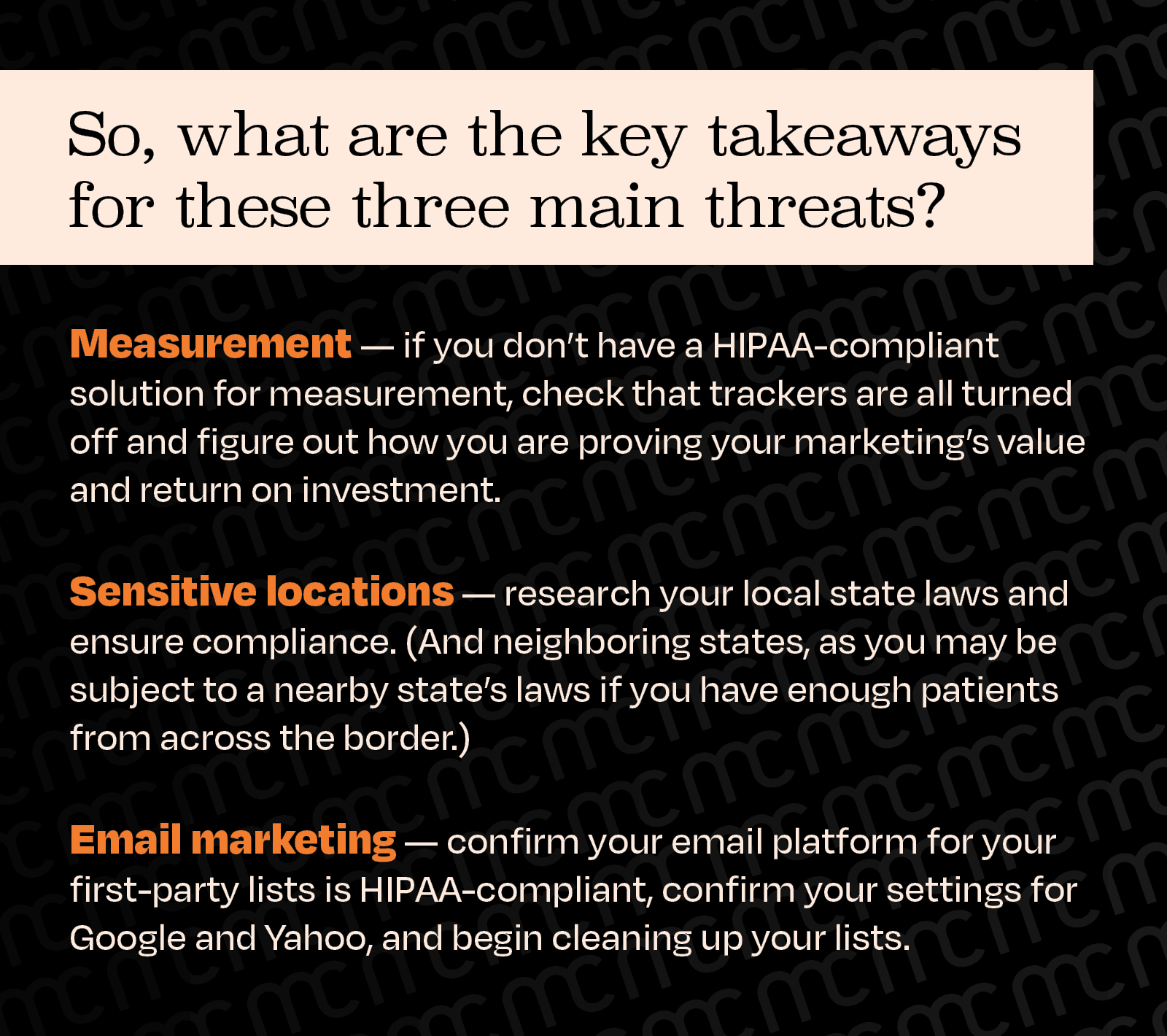
So, what are the key takeaways for these three main threats?For measurement, if you don’t have a HIPAA-compliant solution for measurement, check that trackers are all turned off and figure out how you are proving your marketing’s value and return on investment.For sensitive locations, research your local state laws and ensure compliance. (And neighboring states, as you may be subject to a nearby state’s laws if you have enough patients from across the border.)For email marketing, confirm your email platform for your first-party lists is HIPAA compliant and begin cleaning up your lists.

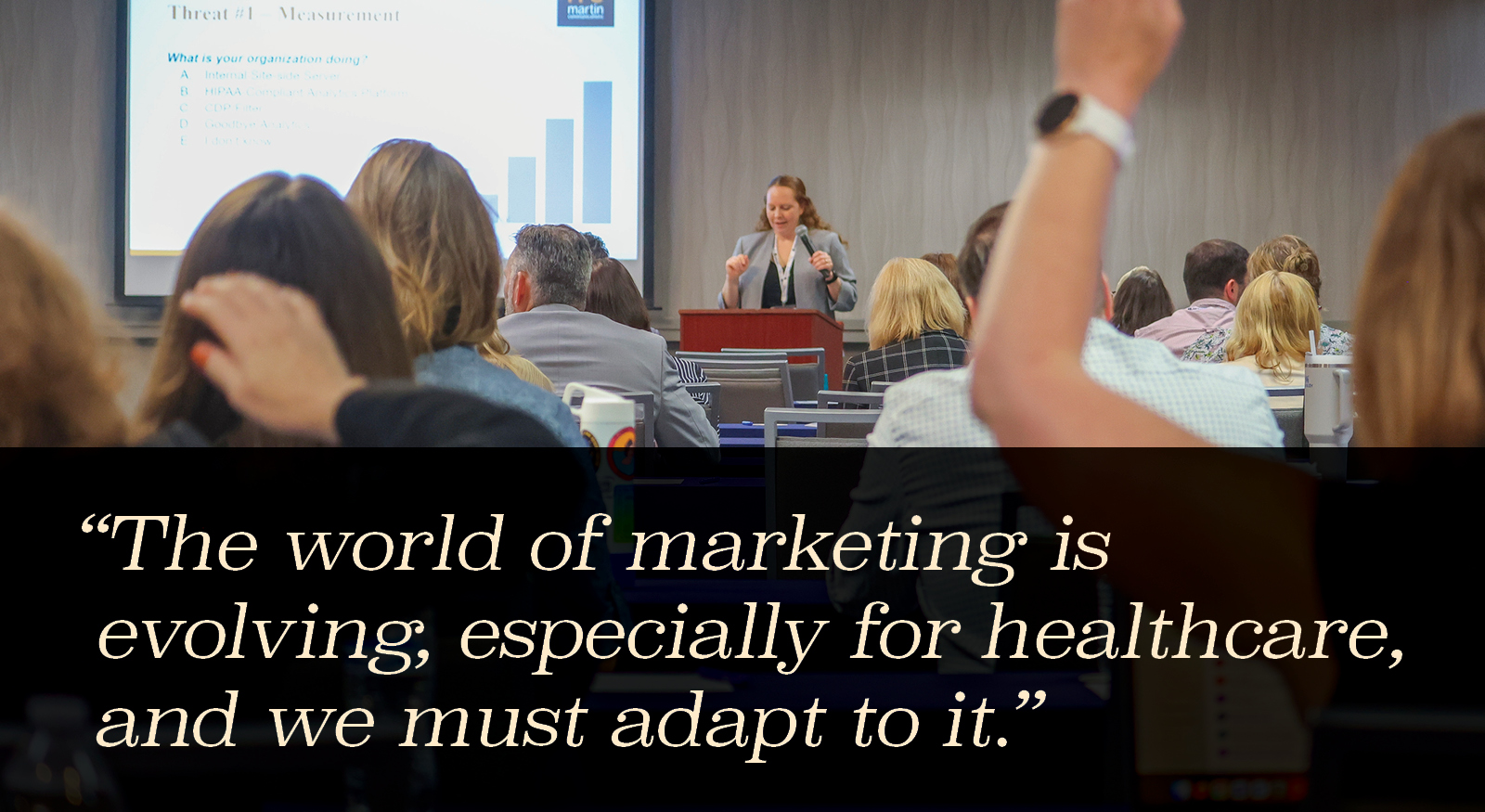
The world of marketing is evolving, especially for healthcare, and we must adapt to it. Don’t let these threats hinder your progress. Equip yourself with the right tools and strategies to navigate the ever-changing digital landscape. We at Martin Communications are here to guide you every step of the way.
For more detailed guidance on how to elevate your strategies, enhance your image, or expand your reach, we’re just a click or a call away. Connect with us at martincommunicationsinc.com/work-with-us/ or dial 717.712.0980.


Should I Put my Marketing Budget in CTV?

While we wouldn’t say TV is dead, we would say that the traditional structure that many of us are used to may become a thing of the past sooner than we were expecting. Study after study being released in 2022 and 2023 shows drastic and rapid changes in consumers’ media consumption patterns. (More on this below.) 

Where Are We, and How Did We Get Here? 

Consumers love choice! With the introduction of DVRs and on-demand cable content in the early 2000s, consumers got used to the idea of having what they wanted when they wanted it. At the same time, technology was advancing to allow companies to profile viewers and households. Put it all together, and we have a recipe for targeted video advertising based on location, interest, and even demographic or household details — just add content! And production studios have plenty of that available, originally through licensing deals, and now also through their own subscription services. 

So here we are in 2023 with a plethora of streaming choices from premium-tier, ad-free subscription options and less-expensive ad-light versions of these same platforms to free services that always have ads. 

If you’re a business-to-consumer(B2C) brand of any size — be it a nonprofit in need of volunteers, a healthcare provider seeking to reach new potential patients, or even a small remodeling firm — what should you be thinking about when it comes to streaming video? 

First, Let’s Start with Some ABCs. 

OTT, CTV, AVOD, Mid-Roll, VCR … the abbreviations used in media can be too much to keep up with sometimes. Let’s start at the very beginning.  

OTT stands for Over-The-Top, a phrase that originated when people began adding internet service to their basic cable packages. OTT nowadays can generally be thought of as a catch-all term for any form of streaming video over the internet. This encompasses viewing on smartphones, computers and tablets, as well as television sets. 

CTV means Connected TV, which is streaming content delivered via internet connected devices, such as Smart TVs and stick/box devices plugged in via USB or HDMI. 

SVOD is subscription video on demand (think Netflix, Disney+, Hulu, etc.).  

AVOD is advertising-supported video on demand, which is usually used to reference lower tiers of subscription services (the same services, but the less expensive versions, as well as options like YouTube or Amazon Prime).  

FAST (free ad-supported TV) services are similar to SVOD and AVOD, but they are free, no subscription required (think of Tubi TV, Freevee, etc.). 

Pre-roll and Mid-roll are terms for the placement of the video ad, typically when delivered via a website. “Pre-“ indicating before the main content like a movie preview at the cinema, and mid-roll meaning as an interruption video, like a normal ad break on TV.  

No, VCR is not a reference to the 80s equipment. It stands for Video Completion Rate, which is a percentile measurement of how many users watched your video to its end. This mainly matters in digital video that isn’t shown through a television device, since those typically have very strong completion rates (the user doesn’t have an option to skip them). 

For the rest of this article, we’re going to focus on AVOD and FAST categories of CTV in particular, as they have become the primary replacement for traditional, “linear” television with ads. (Linear referencing the way that programs are aired, in a line-up, by the way.) 

Back to Our Initial Question: Should I Really Invest My Marketing Budget In CTV? 

The short answer is: You should strongly consider it. 

Streaming is where the largest audience share is. In August 2023, Nielsen reported that “streaming” set a record high of 38.7% share of TV usage the month prior (in July). And for the first time, traditional TV viewership in the U.S. dropped below 50%, with 20% viewing broadcast channels and 29.6% watching cable. These numbers have been trending in these directions for some time now and are projected to only become more disparate in the future with generational shifts. 

(source: https://www.nielsen.com/insights/2023/streaming-grabs-a-record-38-7-of-total-tv-usage-in-july-with-acquired-titles-outpacing-new-originals/)   

Here are some of the PROs for utilizing streaming video ads:

1. This is a great option for those with smaller budgets or that have historically been unable to tap into traditional TV as an option because a broadcast DMA might be too large or cable zones may not quite line up with your service area, and purchasing multiple of these may be inefficient or out of the budget. Streaming video can be targeted by ZIP code making it highly focused and efficient.

2. Instead of the age-old TV conundrum of selecting what programming to purchase (especially if your budget is limited), buying streaming is like buying all of them in a way — you’re on whatever programming your target audience is choosing to watch.

3. Digital video platforms have targeting capabilities well beyond what linear television providers have to offer. While traditional TV has index data on who the largest viewing audiences are for certain shows and channels, your campaign is most likely going to be wasted on some who are not your target audience(s). Addressable video on demand is not a perfect science yet, and you can only target as narrowly as a household with a target individual than an exact person’s device while they are watching, but it may still be less overreach.

With that, you’re able to better customize the content. Are you looking to target just parents of school-age children, or maybe you prefer empty-nesters with high household income? Easily targeted with streaming video. Or perhaps you have multiple audiences? No problem. Each can get a version of creative that speaks to them.

4. Acceptance of ads in streaming is increasing — 90% of streamers are using at least one form of AVOD. One in four of SVODs are at lower ad-supported tiers that have been recently introduced by platforms, and one in three streamers are using FAST services.  (sources: https://www.samba.tv/press-releases/samba-tvs-state-of-viewership-report-finds-growth-of-streaming-choices-for-consumers-usher-in-innovative-new-opportunities-for-advertisers) 

44% of respondents in a recent survey of U.S. adults ages 18-70 said they “enjoyed” or “loved” ads in video streaming platforms, as opposed to 40% on social media platforms and 35% on audio streaming platforms.
(Source: https://www.insiderintelligence.com/content/six-10-streaming-viewers-will-watch-ads-save-few-bucks)   

5. Streaming video doesn’t have to be in lieu of, in fact it can be a complimentary tactic to linear TV. Advertisers can even run a test to analyze the effectiveness of each vehicle for your goals and target audience(s) to find the right mix between the two. 

 There are also a few CONs to consider:

1. The main thing is costs. If you’re not already producing video content, there will be an additional investment to do so. Multiple creatives are strongly recommended to avoid ad fatigue in longer-term campaigns, or to connect with different audiences as mentioned above.  

2. If you’re used to digital display or social media pricing, there will be some sticker shock. CTV impressions will generally be at least four times more expensive than display banners. 

3. Not all inventory is available to everyone — at least not yet. Netflix launched with access to just a few select ad partners and Amazon has some very large budget requirements that behoove national and coop advertisers. But Hulu has launched a beta program for advertisers with smaller budgets, and YouTube is easily accessible as well.  

Final Words 

As with any media campaigns in the digital realm, it is important to know what you are buying — always discuss brand safety guiderails, viewability, and inventory/delivery plans with your CTV video partner or agency. 

And remember, true CTV is a branding vehicle only. You cannot expect immediate conversions on your website because these ads, while digital and not clickable to take a user straight to your website on the same device. Have your end goals in mind and be sure you have a plan to realistically measure the outcomes of the campaign. 

How Martin Communications approaches design

Meet the head of our design department: Michael Keesee. He’s been making sure everything that leaves our hands looks good for the past three years.

Ensuring that every piece we create supports the client’s brand positioning and identity, he supports our design team in creating everything from traditional and digital ads to high-impact videos and responsive websites. As head of the department, he also fosters an environment of creativity, flexibility, and growth for the design team. “I also like to stay up to date on trends and best practices within design, media, and content creation,” notes Michael.

How MC approaches design

Before we begin a design project at Martin Communications (MC), we must understand three things:

  1. The intended audience
  2. The message and tone
  3. How the piece will be used

“Once we have the answers to these questions, we can properly problem-solve to find the best design solution for the task at hand. We use our collective knowledge of the client’s market, consumer psychology, and current cultural trends to develop a piece that effectively communicates to the intended audience.”

“This is why working so closely with our media team allows us to have a leg-up compared to other agencies — both teams can collaborate on a given piece of creative for a holistic solution, rather than each doing their job within a silo and sending it down the line.”

Apart from the actual design work, Michael explains how his department operates: Although we designers aren’t necessarily known for our rigid processes or attention to details, it’s exactly those things that allow us to be successful on the design team at MC.

“We rely on project management software, a meticulously organized server, and our forward-thinking Project Coordinator, Ben, to ensure our tasks are dispersed evenly, files are stored properly, and everything is completed on time.”

Further describing the design team’s daily activities: “The designers are given several tasks per day — anything from t-shirt designs to animated digital ads — and are charged with interpreting the creative direction to develop an ideal design solution. They are then responsible for sending to me and at least one other team member for rigorous quality control and proofreading before sending to the Account Manager for that client.”

“Each designer has brand assets and style guides at their disposal, which makes it much easier to switch between clients for each task they’re working on. We prefer to partner with clients long-term, so everyone on our team is familiar with each brand’s intricacies.”

Learn more about our creative services here.

Back to Michael

Before joining the team at Martin, Michael got his education at the Art Institute of York where he had the unique opportunity to learn from the first-hand experience of veterans of the design industry. After completing his education, he moved into the workforce. “I worked in an in-house marketing department for a group of large regional remodeling brands, starting as the only designer and building up a creative team of several designers and a full-time video producer over 10 years.” All the while, Michael also maintained a robust client base outside of his in-house role, specializing in hand-lettered logos based on market research and consumer psychology.

When asked about his current role at Martin Communications, he said, “I’d be remiss to describe what I love about my position without mentioning the culture of MC. It’s refreshing to work at a place where personal responsibility, innovative thinking, and true work/life balance are valued.”

In addition, he notes: “Coming from a background of brand-centric work, it’s fun to partner with so many different clients, getting to know their brand intimately and helping them better connect with the right audience.”

Outside of work hours, Michael’s passion for design continues. “Design is a huge part of my life and I’m almost always thinking about it. I have a Pennsylvania-themed store called Penna Shirt Co. (pennashirts.com) that has allowed me to hone my hand-lettering and illustration skills and learn more about e-commerce and digital marketing.”

Need help with design or ideas to refresh your creative? Reach out to us through the link at the bottom of this page; we would be happy to help!

3 reasons to use streaming audio over traditional radio

When you jump in your car, do you listen to the radio or plug in your phone and stream your favorite playlist?

Chances are, it’s the latter, especially with CarPlay becoming standard in newer vehicles.

According to a 2020 report by research firm Strategy Analytics, fewer people around the world are using AM/FM car radios due to various factors, including a marked decline in commutes to work. “2020 is the year that in-car AM/FM radio has hit the proverbial ‘iceberg,’” the report said.

Derek Viita, report author and Senior Analyst of Strategy Analytics’ IVX group, said, “While radio still has unique advantages, the pandemic has only worked to increase adoption of other media sources,” Viita continued, “some radio providers in the West are reporting that their ratings have nose-dived because many of those who listened on their commute have not rejoined from home.”

When you’re at home relaxing, do you dial into your favorite radio station on your boombox or open your favorite audio streaming app on your phone or smart device? Again, chances are the latter.

You might think, ‘well, 2020 was a few years ago’, however, a 2022 statistic states that 74% of U.S. internet users, or 222.7 million people, listened to digital audio. (That’s two-thirds of the U.S. population!) Of these digital audio listeners, 40% are using ad-supported versions. Though the growth of that market share will slow, the time each listener spends is rapidly increasing. In 2022, U.S. internet users spent nearly as much time streaming music and podcasts as they spent watching broadcast TV daily (which still accounts for the largest share of U.S. internet users’ time spent with media).

The road to audio streaming began in 1993 when the MP3 was introduced and the ability to download music through the internet was launched. More than two decades later, what began as having to purchase individual songs has turned into the ability to listen to all the songs you wanted, as long as you listen to the occasional ad or pay for the monthly subscription.

According to data from the Recording Industry Association of America, streaming grew from 7% of the U.S. music market in 2010 to an incredible 80% at the end of the decade. And according to research conducted by Edison Research:

  • Thanks to streaming audio’s ability to be highly personalized and dynamic, 43% of streaming audio listeners say the audio ads are more relevant to them.
  • And 42% of listeners stated that audio ads are more likely to capture their attention than ads seen or heard in other places.

Now, is there a time and place for traditional “terrestrial” radio, especially when, according to Nielsen, radio still reaches 86% of Americans 18+ every week? Of course, but that’s not what this article is about.

Reason 1: Targeting

Understanding your audience and figuring out how to reach them is crucial to advertising. Where traditional radio listenership relies on estimates, the innate nature of digital media provides advertisers with a better understanding of who’s listening.

Demographics, location, device usage, and listening habits are things that you can target with streaming audio.

Streaming Audio versus Traditional Radio by Targeting

As you can see, the targeting capabilities with streaming audio can be robust, enabling advertisers to meet consumers where they are at with messaging tailored to them. This precision in targeting is not available through traditional radio.

According to the 2023 released streaming statistics by Headphones Addict, U.S. users also almost entirely use streaming to listen to music. Here are the use percentages of music streaming services by age group:

  • Age 13-25 – 99%
  • Age 24-39 – 98%
  • Age 40-55 – 96%
  • Age 56-74 – 89%

Reason 2: Key Performance Indicators

Key performance indicators (KPIs) – are a way to track campaigns and know if they are providing results. For example, when running spots on traditional radio, you get a report back at the end of the campaign on the days and times your spot was broadcast, even with an estimated total reach. When you place an ad on a streaming audio platform, you gain insight into much more.

Like other digital advertising channels, data is available for the four basic performance metrics:

  1. Impressions – The total number of ads served.
  2. Reach – The number of unique people who heard your ads.
  3. Frequency – The average number of times each person heard your ads.
  4. Clicks – The number of times an ad banner displayed was clicked on, sending a listener directly to your website.

A metric unique to streaming audio is the Audio Completion Rate. This is the percentage of ads served that were played to the end.

The benchmark for audio completion of ads on Spotify is 91% — in traditional radio, you can’t account for if someone changes stations when commercials come on (and where you only know when the spot was played and their estimated listenership).

Streaming Audio versus Traditional Radio by Key Performance Indicator

With the ability to track, respond, and modify approaches for target audiences, streaming audio makes optimizing easier and allows for a more effective campaign.

Reason 3: Cost

Though you can allocate the same amount to traditional radio and streaming audio, what you receive in return is vastly different. Many streaming platforms have minimum spend requirements of just a few hundred dollars ($250 is the minimum for Spotify). In contrast, the necessary budget for traditional radio depends on your market but typically is in the thousands.

With the ability to target more precisely, obtain accurate reporting, and maximize your budget, streaming audio is worth considering for your next targeted campaign.

If you would like to learn more about streaming audio or adding it to your marketing efforts, contact us today, and we would be happy to help!

Additional Resources: